
When the Plan Is Not the Product

How West St. Paul stopped writing strategic plans and started building a system that actually runs one.
Most strategic plans don't fail because they're poorly written. They fail because the operational side of a city runs on an entirely separate track, and nobody ever builds the bridge. The plan lives in a binder or a PDF, the real work lives in everyone's inboxes and department meetings, and by March of year one the document is already gathering dust while decisions get made somewhere else entirely.
West St. Paul, Minnesota knew this feeling well. When City Manager Nate Burkett reached out to Partners in Public Innovation, his city wasn't starting from zero, and that was actually part of the challenge. West St. Paul had been through three strategic plans in six years. Each one had made the organization more disciplined, whittling 20-plus objectives down to a manageable handful and replacing vague intentions with yes/no milestones.
But the next question, the harder one, was still unanswered: are our choices actually working?
The gap between a good plan and a working one
What Nate's team had built was a capable organization that knew how to narrow its focus and make deliberate choices. What they hadn't yet figured out was how to know, mid-year, whether those choices were actually holding. They could produce a solid year-end report, but they couldn't tell you in May whether they were going to make it there.
The missing pieces weren't exotic or particularly surprising, but they were very specific:
genuine alignment on the harder priorities (the ones where Council doesn't naturally land in the same place),
a measurement system that included leading indicators alongside the lagging ones,
the connective tissue between the plan and day-to-day operations.
That last piece is the one most strategic plans skip entirely. Shared ownership, a clear rhythm for checking in, and a tracker that gives leadership a live-view of progress are unglamorous infrastructure, but they are exactly what separates a document that gets used from one that gets shelved.
What West St. Paul needed wasn't someone to write a better plan. It was a partner who could hold the hard facilitation, build the measurement system into the plan from the start rather than tacking it on afterward, and hand off tools and habits that staff could actually run without adding significant lift on top of their existing work.
That's where the PPI team came in.

How we worked
We designed the engagement in five phases, and the sequence was as intentional as the content. Each step was built to create the conditions the next one would require, so that by the time the city had a finished plan, the people responsible for running it had already been part of building it.
1 Listening & Synthesis
Before anything else, PPI needed to understand the terrain. We interviewed the Mayor and all six Council members, gathered leadership perspectives on pressure points and aspirations, and reviewed organizational documents alongside data on the city's existing infrastructure and practices. The goal wasn't to arrive at the retreat with answers already in hand; we instead walked in knowing where alignment existed, where it didn't, and where the city had blind spots it hadn't yet named.
2 Interactive Retreat
The retreat was a full day with the Mayor, Council, City Manager, Assistant City Manager, department heads, and key staff, and we designed it around a specific conviction:
strategic direction needs to be built in the room, not presented to the room.
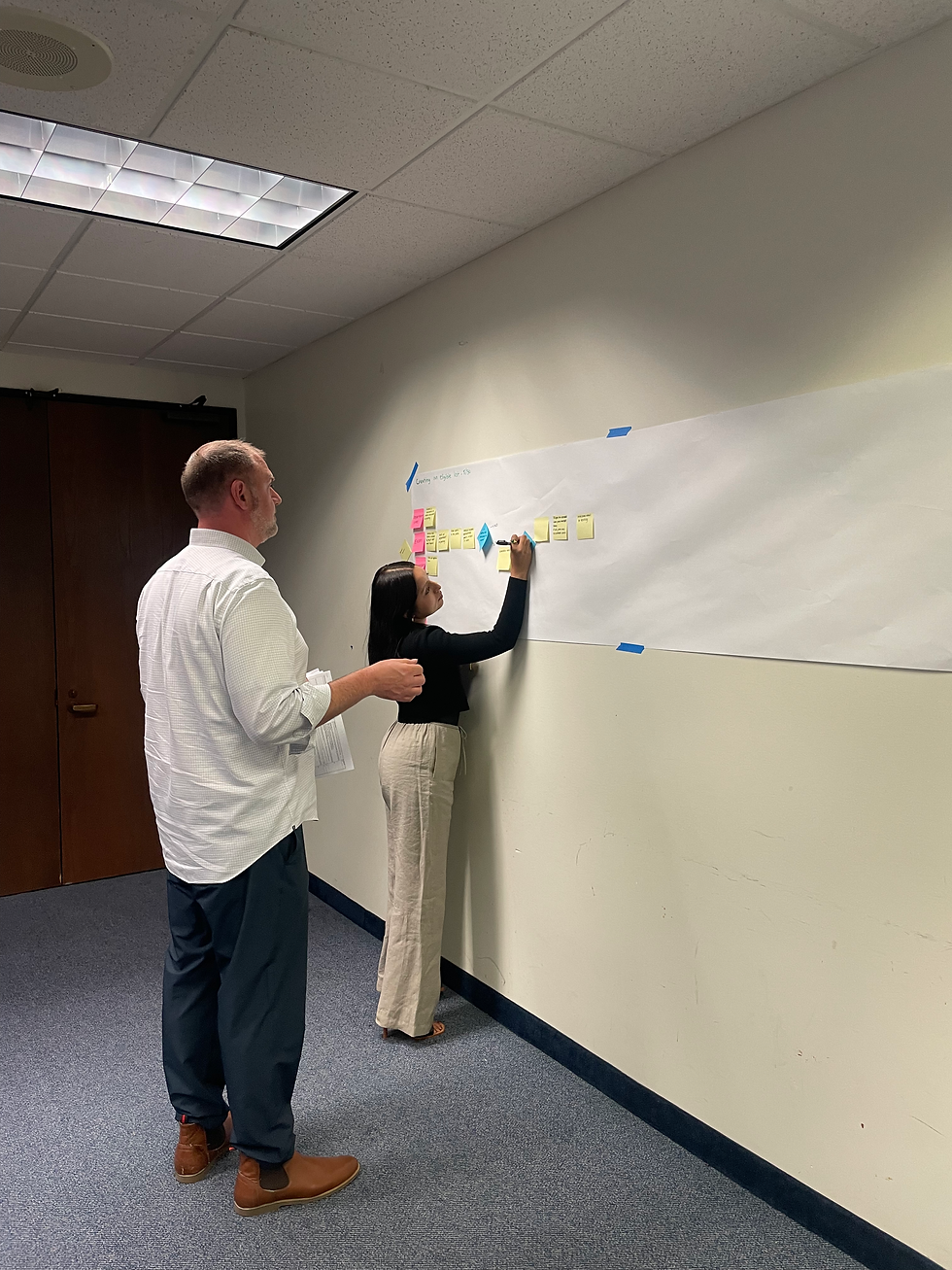
The day opened with vision, mission, and values as deliberate foundation, establishing shared ground before moving into the harder conversations. From there, the group worked through the real challenge of distinguishing operational commitments from genuine strategic priorities, honed in on what shared success for those priorities would look like, and then did a hands-on card sort with existing measures so everyone could see clearly what they already had and where the meaningful gaps were. By the end of the day, the team had landed on four strategic priorities with objectives and draft measures, and they had done the intellectual work themselves rather than receiving someone else's conclusions.

3 Action Design
The retreat gave direction. This phase turned that direction into a staff-informed project portfolio. PPI facilitated small cross-functional groups for each priority, running sessions from root cause analysis through brainstorming, clustering, and validation. PPI then synthesized the top ideas into 31 scoped project descriptions and sent them back to staff through a survey that asked people to rate each project on impact, effort, and likelihood of their own involvement. That last dimension mattered: it weighted the responses from the people closest to the work, so that by the time leadership sat down to make prioritization decisions, they had real staff data on the table rather than just vibes.
4 Prioritization & Project Plans
But, 31 projects across four priorities is a portfolio, not a plan. This phase was about making real choices, and PPI facilitated a Now/Next/Not Yet prioritization with leadership and department heads. The framework accounted for urgency, synergies, early wins, and dependencies, and it kept staff perspective and leadership judgment in productive tension rather than treating either as the final word. After the final projects were set, PPI worked one-on-one with each project lead to develop scope, timeline, stakeholders, and project-level measures so that implementation would have its own accountability built in from the start, rather than relying solely on year-end KPIs.
5 Implementation Framework & Toolkit
The last thing PPI built wasn't a document, it was a rhythm. The plan runs on a Plan-Do-Review-Refresh cycle with explicit roles and a monitoring cadence so that the plan doesn't depend on anyone remembering to check in-- the check-ins are already scheduled.
Every tool PPI handed off was designed around a single principle: the plan should be easier to run than to ignore. Rather than leaving West St. Paul with a stack of separate documents, PPI built one integrated toolkit where each piece connects to the others and serves a specific function in keeping the plan operational through the year.
What's different now
West St. Paul adopted a five-year strategic plan covering 2025 through 2030 with four clear priorities, corresponding objectives, KPIs, and a pipeline of prioritized projects, each with an owner, a timeline, and measures that report progress during the year rather than waiting until December to tell leadership whether they made it.
But the more meaningful outcome aren't the documents. Council and staff don't just know what the priorities are; they understand why those are the priorities and not something else, because they were in the room when the choices got made, doing the card sort and voting on the projects themselves. That depth of involvement is what makes the plan hold up when the work gets difficult and competing pressures start to push back against it. They recognize themselves in it, and that recognition is what keeps it alive.
Early projects were already in motion before the plan had been formally adopted for very long, and that is not a small thing. Strategic plans typically sit for months before anything moves, while everyone waits for someone else to declare it "officially started." West St. Paul avoided that trap because implementation was built into the process from the start. The people responsible for doing the work helped shape the plan, which made ownership clearer and follow-through more realistic.

Want a strategic plan that doesn't sit on a shelf?


Comments